
Construction Monitoring
DYWIDAG presents a suite of specialised monitoring solutions designed to meet the diverse needs of the construction, demolition and asset protection sectors - from the structural integrity of existing infrastructure to the precise measurement of heave and pore water pressure, and from tunnel convergence to environmental impacts.
What we monitor
Adjacent and neighbouring structures
Construction work often transmits movement into the ground and the structures around it, and the owners of those structures expect evidence that their property has not been harmed. Perimeter buildings, retaining walls, boundary walls and heritage facades can all be exposed, and a potential claim made months after completion is difficult to answer, without a continuous record.
DYWIDAG monitors neighbouring structures before work begins, until after it finishes (& beyond as required). Condition and dilapidation surveys establish the state of each property at the outset. Rotation, vibration, displacement and crack monitoring then run through the works, detecting structural deformation or damage and ensuring the safety and stability of surrounding infrastructure. Tilt sensors, crack gauges, optical displacement sensors, precise levelling and automated total station observations are selected to suit the structure, the access available and the sensitivity agreed with its owner.
- Rotation, vibration, displacement and crack monitoring of perimeter buildings, retaining walls and heritage facades.
- Condition and dilapidation surveys before work begins, and a comparison survey on completion.
- A defensible, continuous record against trigger levels agreed with each affected owner
Related Projects
Ask us about monitoring neighbouring structuresSystems we use in this space
Related products
 Learn more
Monitoring Data Management
Integrated with DYWIDAG’s smart products and third-party sensors, our data management platform delivers actionable insights to enhance infrastructure safety, performance, and decision-making.
Learn moreDYWIDAG Smart Guard
Detecting and verifying tilt events in under 5 seconds, in optimal conditions, it combines wireless sensors, integrated cameras, and DYWIDAG's Infrastructure Intelligence to provide instant situational awareness
Third-party asset protection
Work close to an operating railway, a metro tunnel, a highway or a buried utility is carried out under the asset owner’s conditions. Those conditions set exclusion zones, predicted movement limits and reporting obligations, and they are enforced.
DYWIDAG designs and operates the monitoring that those obligations. Movement of the third-party asset is measured independently of the works, against the limits written into the agreement, and reported in the form and at the frequency the owner requires. Track geometry, tunnel convergence, structural movement of bridges and retaining structures, ground settlement above and alongside the asset, and vibration from piling, excavation and demolition are all covered.
Instrumentation is selected for assets that cannot be taken out of service and for locations with no power or communications: wireless tilt sensors, automated total stations, in-place inclinometers, vibrating wire piezometers, crack gauges and vibration meters, reporting through gateways to Infrastructure Intelligence.
- Independent measurement of railways, tunnels, highways, bridges and buried utilities against the limits in the asset protection agreement
- Reporting in the form and at the frequency the asset owner requires, with alarms escalating under the agreed protocol
Related Projects
Ask us about third-party asset protectionSystems we use in this space
Related products
Learn moreDYWIDAG Smart Guard
Detecting and verifying tilt events in under 5 seconds, in optimal conditions, it combines wireless sensors, integrated cameras, and DYWIDAG's Infrastructure Intelligence to provide instant situational awareness
Learn moreMonitoring Data Management
Integrated with DYWIDAG’s smart products and third-party sensors, our data management platform delivers actionable insights to enhance infrastructure safety, performance, and decision-making.
Ground and groundwater movement
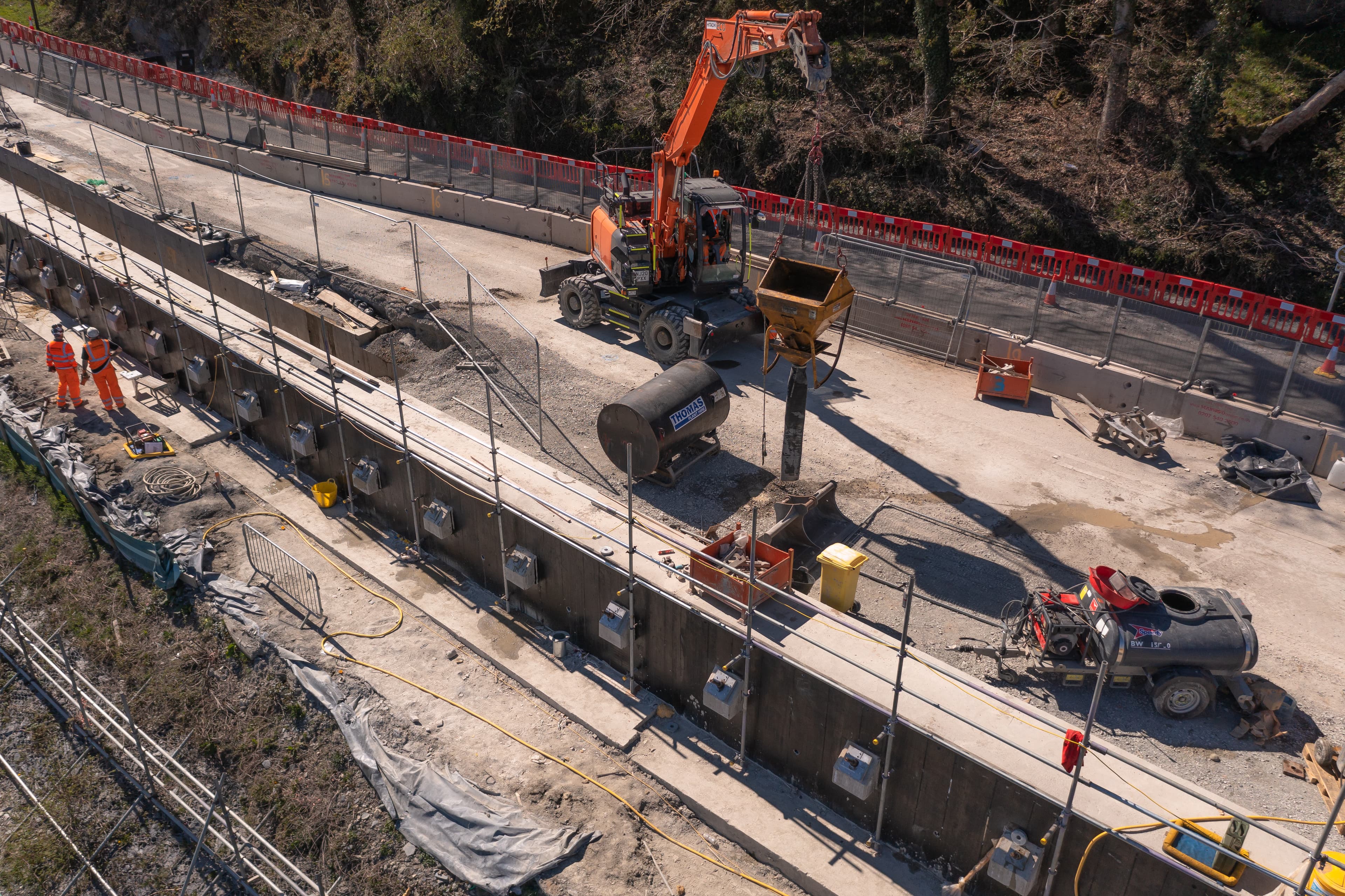
A deep excavation could be supported by a system that is temporary by design: sheet pile or diaphragm walls, props, ground anchors, berms and falsework, each carrying load that changes as the dig advances and as the permanent works take over. Deflection and load have to be measured against the design assumptions at every stage.
DYWIDAG monitors the support system through the full construction sequence. Wall deflection is measured by in-place inclinometers within the wall and by automated total station observation of wall-mounted prisms. Prop loads and ground anchor loads are read by load cells and strain gauges, so that structures are not subjected to excessive stresses beyond their design capacities. Crane bases, retained facades and falsework are instrumented with tilt sensors and optical displacement sensors where their stability governs the programme.
Monitoring is staged to follow the construction sequence, with instruments installed, relocated and removed as the works advance, keeping equipment on site only where it is needed.
- Wall deflection by in-place inclinometers and automated total station, with prop and ground anchor loads read against design capacities
- Crane bases, retained facades and falsework instrumented, with monitoring staged to follow the construction sequence
Ask us about ground & groundwater movement monitoringRelated Projects
Excavation, retaining structures and temporary works
Ask us about temporary works and excavation monitoringExcavation, piling, tunnelling and dewatering can all redistribute stress and water in the ground, and the surface expression of that is settlement or heave, including some distance from the activity causing it. The mechanism is subsurface, and the movement reaches neighbouring structures before anything is visible at ground level.
DYWIDAG assesses soil and rock stability by measuring ground inclination, pore water pressure and ground deformation, detecting movements and ensuring safety and stability. Measurement is taken within the borehole by in-place inclinometers reporting automatically at a configured interval, and by manual probe survey where verification is required or where power and communications are impractical. Piezometers record pore water pressure and groundwater level, which commonly explains the movement observed, and extensometers and settlement cells quantify vertical movement at depth and at the surface.
- Weather is recorded alongside the ground data, because wind, rainfall and temperature are frequently external contributing factors behind the movement.
- Settlement and heave quantified by extensometers and settlement cells, with rainfall, wind and temperature recorded as context.
- Ground inclination, pore water pressure and deformation, with in-place inclinometers reporting automatically and manual probe surveys in the same borehole
Tunnels and underground structures
An existing tunnel beneath a construction site responds to what happens above it. Piling, excavation and surcharge change the load on the ground around the tunnel bore, and the result can be convergence of the cross section, deformation of the lining or the opening of cracks within it. The tunnel is usually in service and cannot be inspected on demand.
Monitoring of tunnel convergence is vital for ensuring the ongoing stability and safety of underground structures, giving information on known and potential issues such as ground settlement, structural deformation and lining deterioration. DYWIDAG measures movement of the cross section against the kinematic envelope, monitors the portal face for cracking and rotation, and tracks the lining for deformation and crack development.
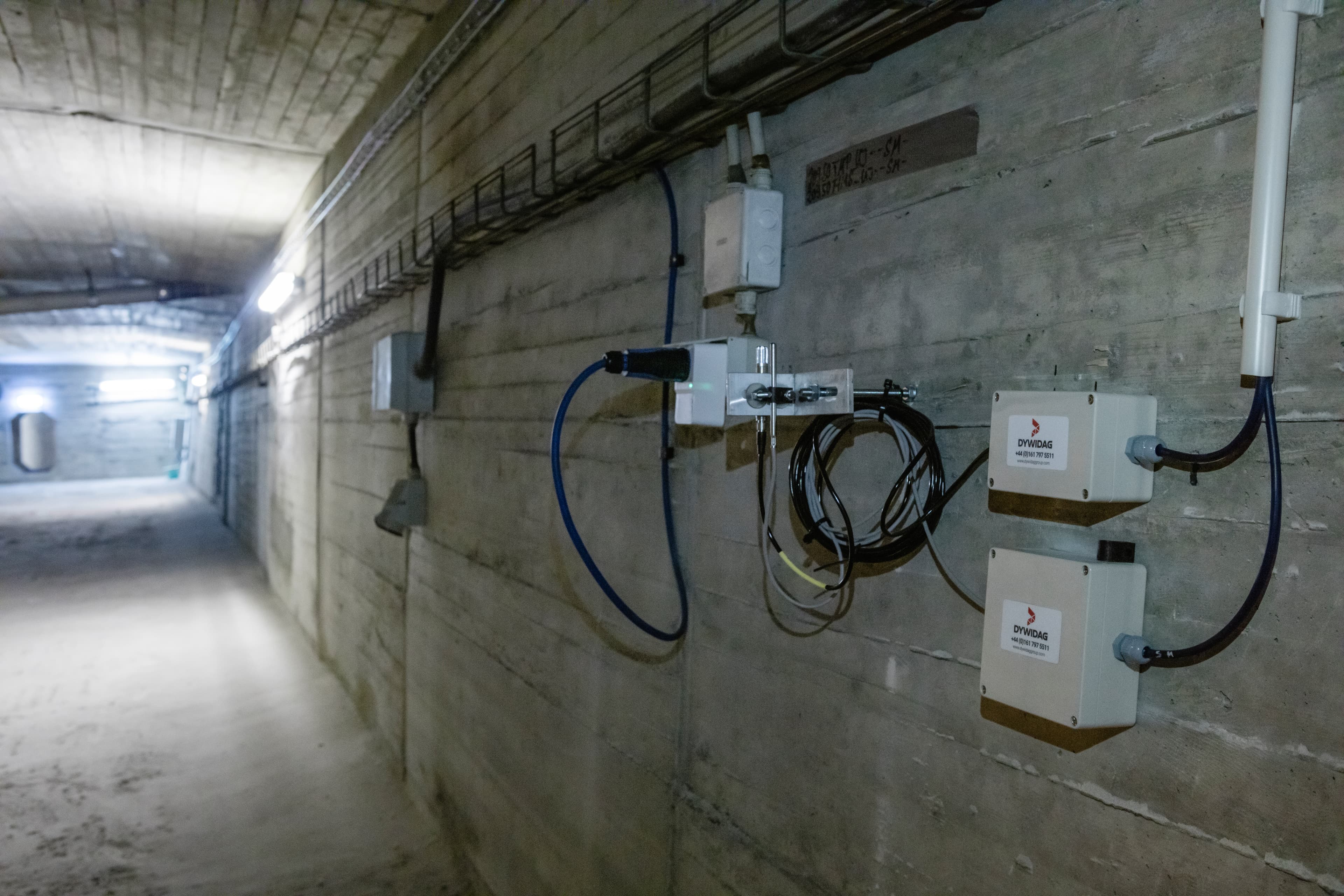
There is rarely power or communications where the instrument has to sit. Convergence arrays, tilt sensors, crack gauges and optical displacement sensors report through data loggers and gateways, with repeaters extending coverage along the bore.
- Cross-sectional convergence against the kinematic envelope, with lining deformation, cracking and portal face rotation tracked
- Arrays carrying their own power and communications, installed by rope access and confined space trained technicians
Ask us about tunnel and underground monitoringRelated Projects
Noise, dust and vibration
Ask us about noise, dust and vibration monitoringConsent to build is frequently conditional on what the site emits. Noise, dust and vibration limits are written into planning conditions and local consents, and a complaint from a neighbour or a claim of damage from an adjoining owner is answered with measurement records or it is not answered at all.
DYWIDAG provides assessment and management of noise, dust and vibration levels, to mitigate potential impacts on surrounding communities and ecosystems. Continuous monitors are positioned at the site boundary and at sensitive receptors, recording against the limits set in the consent. Vibration is measured by triaxial meters that detect a threshold breach at the sensor itself, which matters during piling, demolition, breaking and compaction, when levels change within seconds.
Measurement runs continuously, so the record covers the whole period of the works and not only the occasions someone attended. Readings and alarms are held in Infrastructure Intelligence with automated notification by email or SMS.
- Noise, dust and vibration measured continuously at the boundary and at sensitive receptors, against the limits set in the consent
- Triaxial vibration meters detecting threshold breaches at the sensor during piling, demolition, breaking and compaction
Survey, and automated total stations
Ask us about surveys, and automated total stations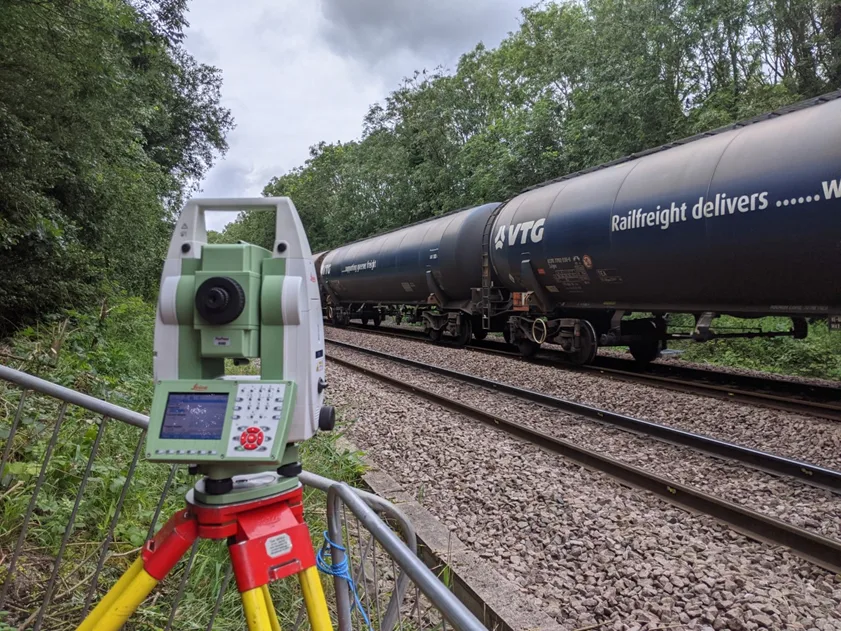
Not every measurement comes from a fixed sensor, and on a construction site the two have to agree. Survey establishes the baseline the instruments are judged against, reaches structures where no sensor can be fitted, and provides the independent check an asset owner or adjoining owner will accept.
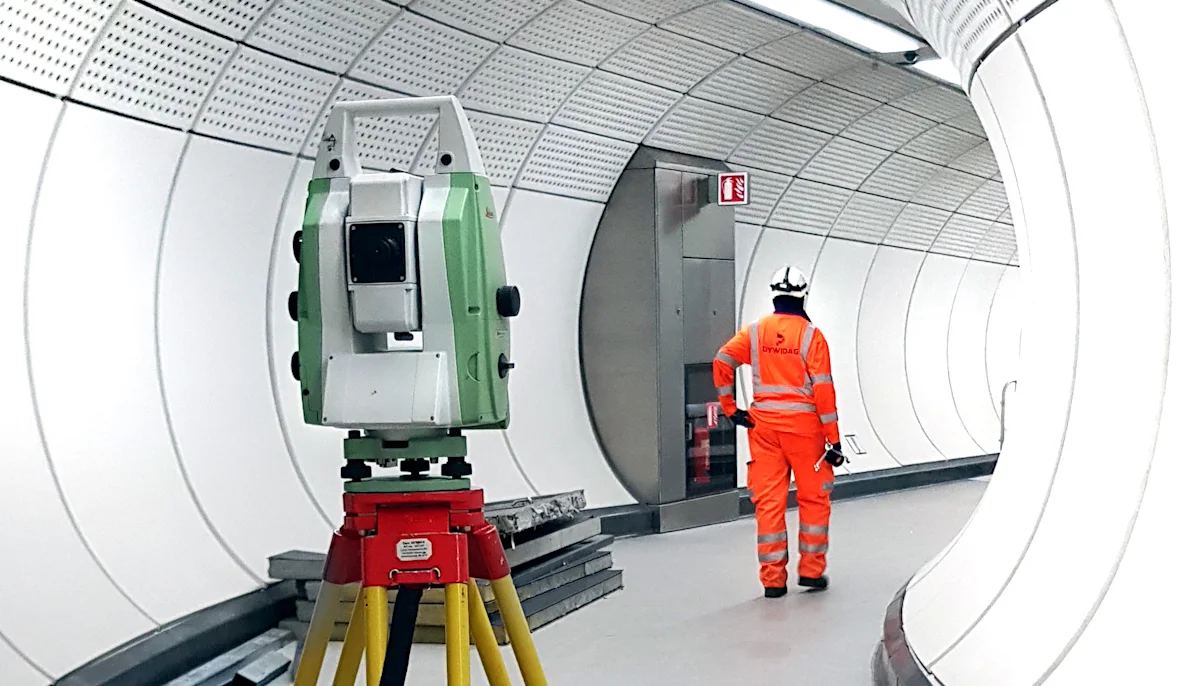
Our team comprises highly skilled surveyors and monitoring technicians employed directly by us, available around the clock and in any environment. Core surveying expertise covers sub-millimetre precision levelling, advanced topographical surveys utilising GNSS and GPS technology, high-definition 3D laser scanning and point cloud surveys, structured deflection surveys, digital imaging correlation, targeted patch scanning, and thorough condition and dilapidation evaluations.
Automated total stations extend this to continuous operation. Prism arrays installed on neighbouring buildings, retaining walls and the excavation itself are observed to a schedule, giving survey-grade three-dimensional coordinates without anyone entering the working area. Observations report into Infrastructure Intelligence alongside the instrumented systems, so manual survey, automated survey and sensor data are read together against the same trigger levels.
- Sub-millimetre precision levelling, GNSS topographical survey, 3D laser scanning and point cloud, patch scanning and deflection surveys
- Automated total stations observing prism arrays to a schedule, reported alongside the instrumented systems against the same trigger levels


Real-time data, intelligent reporting, escalating alarms, and smart alerts with anomaly detection

3 Related downloads
Structural Health Monitoring (SHM) - Brochure - DYWIDAG UK & Ireland
Manual Monitoring and Survey Services - Brochure - DYWIDAG UK & Ireland
Infrastructure Intelligence - Product Guide - DYWIDAG Global
Why choose DYWIDAG for construction monitoring?
Tailored to your project
Monitoring solutions designed around your structure, site conditions and project requirements.
Earlier insight into risk
Continuous, targeted monitoring helps identify changes and potential issues before they escalate.
Expertise behind the data
Our specialists help turn monitoring data into meaningful insight to support informed decisions.
Support throughout construction
From temporary works and excavations to anchors, basements and facades, monitoring can support critical stages of construction.
Monitoring across every stage of construction
With DYWIDAG, stakeholders gain access to tailored monitoring technologies that enhance safety, efficiency and compliance across all phases of construction operations.
Our solutions also extend to anchor monitoring, facade engineering and basement construction, providing a holistic approach to safeguarding projects and environments in these challenging industries.